
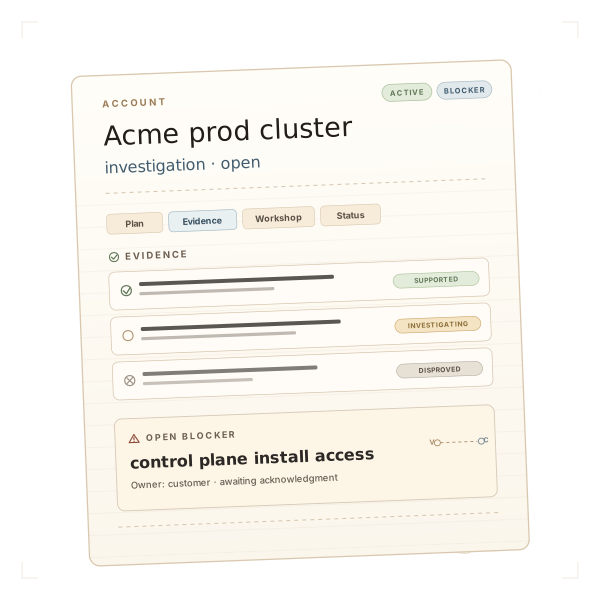
Two orgs.
One investigation.
Ashlar Workspace is the collaborative workspace your support tickets pretend to be.
I. The problem
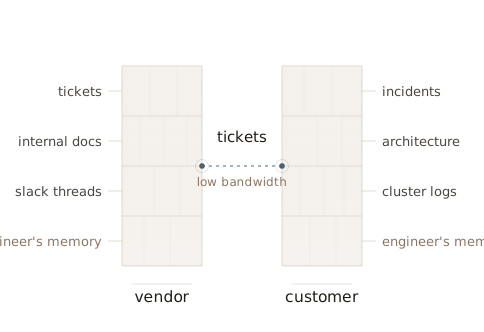
Mountains of Data
Dozens of tools
No fast and safe way to share information
Engineers on both sides trickle updates into a ticket. Eventually someone opens a conference bridge and everyone watches one engineer share their screen. Progress is slow and painfully single threaded.
∴ Tools were built for one organization at a time.
II. Why now
AI changes the math.
Before
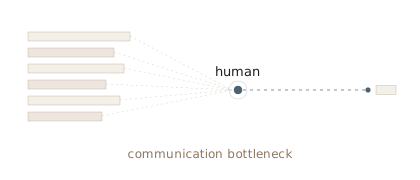
To update a ticket, a human needs to convert raw context into something readable by another human. This process is slow and lossy.
Now
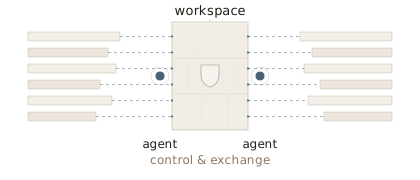
Agents read raw structured context directly. Cross-org context is suddenly worth exchanging on its own. The tooling to exchange it is suddenly worth building.
III. The product
What Ashlar Workspace is,
in three pieces.
fig. ii the workspace
Peer workspace
Vendor and customer write to the same workspace with equal permissions. Scope (Private, Org, Global) and sensitivity (normal, confidential, secret) are orthogonal, so you can keep something internal while still working in the shared space.
Bring your own AI
The workspace exposes itself as MCP tools. Drive it from Claude Code, Claude Desktop, or any MCP client. We don't bundle a model. Your data stays on your side of the contract.
Bilateral governance
Nothing crosses the boundary without acknowledgment from both sides. Server-side DLP runs at every promotion. The audit log is hash-chained and exportable. Policy is a first-class engine, not buried in code.
IV. The founder
Built by an engineer
who lived the problem.
I run support engineering for a vendor selling to technical customers. The architectural precursors originated there — revenue growth has vastly outpaced our team because we scale with tooling instead of headcount. Now I'm building the platform standalone. Working demo this summer.
Will Krause · linkedin.com/in/williamkkrause
V. The invitation
See it before it ships.
Talking to design partners and early hires. If you have strong opinions about how enterprise vendors and their technical customers should work together, even better.